
Monday, June 13, 2011


Wednesday, June 8, 2011

Sunday, June 5, 2011






Friday, June 3, 2011


Wednesday, June 1, 2011
TransJakarta Busway

Jakarta is congested, its streets simply cannot digest this many vehicles. Jakarta’s government decided to implement the shock doctrine in 2005. One way was the 3-in-1 policy during peek hours (minimum of three persons per car, which is simply sidestepped by renting so-called jockeys). The other way was to reserve one lane for designated buses, the so-called TransJakarta Busway. The TransJakarta Busway and the three-in-one meet mockery, just because it's felt by the well-to-do that it eats up ‘their’ space. And to get people out of their private cars and into the busway the buses needed to be clean and safe, which certainly was true in the beginning, but due to rapid expansion and low maintenance the quality has deteriorated and waiting time at bus stops has increased.
traffic accident

Around the corner of my office is the police station and when a traffic accident has occurred the damaged cars are parked in front of the station for further investigation. Every time an angkot – minibus public transportation – is involved in a traffic accident its damage is always on its front, which means that angkot drivers rear end the vehicle driving in front.
Tuesday, May 31, 2011


writing the city Bandung, riding its angkots...

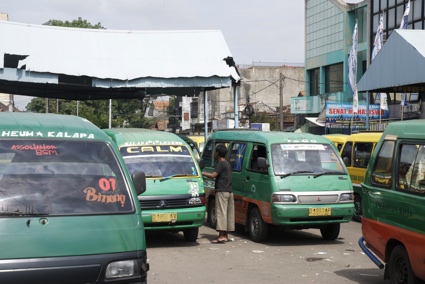
Last week I started a voyage. Not around the globe or an exotic location but a venture into the streets of the city I live in – Bandung, Indonesia. So this is the basic idea: I am going around the city by angkot – minibus public transportation – each time I will take a different route to end up at a different terminal. Last week I started by taking the Dago-Kalapa angkot from Dago, nearby my home in Kanayakan, to the terminal Kebon Kalapa (for those of you who are familiar with Bandung, this is just south of alun-alun and just north of monumen lautan api; see the map above for the pointing finger). So far it has been lots of fun – seeing a new part of the city where I have lived for the better of the past eight years, joking with the drivers, having coffee at the terminal – while at the very same it has so far been pretty exhausting – beside the five odd hours I spent per week in the angkot to go from my home to my office vice versa I spend now numerous extra hours on the streets riding the city’s minibuses. The goal is not only the see more of the city I call my home but also to try to find new ways to write (about) the city. For my first impressions of the Kebon Kalapa terminal see the next post.

Thursday, May 26, 2011

anakharam ibukota

We in Bandung are the evil children of the capital city, i.e. Jakarta (ibu=mother, but ibu kota means capital city (literally: mother city or mother of cities), anak=child(ren) and haram=sinful).
propaganda

"Siliwangi adalah rakyat Jawa Barat, rakyat Jawa Barat adalah Siliwangi," which means: "The army division Siliwangi is the people of West Java, the people of West Java are the army division Siliwangi." The army division Siliwangi's headquarter is in Bandung, the capital of West Java province, and this year it exists 65 years. The text on the banner is New Order lingo (New Order was the name of Suharto's authoritarian regime, which ended in '98), I cannot imagine that many still buy into this kind of language, but why then are these banners all around Bandung sponsored by major companies?

Saturday, May 21, 2011

Tuesday, May 17, 2011
TINA
Recently, I read Andy Merrifield’s book on Guy Debord. Debord is the author of the 1967 book The Society of the Spectacle, which he also turned into a movie, in both book and film he claims that social relations are mediated by empty signs (images, logos, brand names, celebrities, spin doctors, marketing, pr, etc.), and he is one of the founders of the Situationist International. Merrifield writes about the eighties: “just when the Right was triumphant about its ‘meta-narrative’ of the market, the Left started to proclaim its incredulity to all meta-narratives, to all big stories about humanity and progress. Soon they’d begin to proclaim a viewpoint called ‘postmodern’. […] Thus the paradox: the Right had set off on its long march across the entire globe, dispatching its market missionaries, spreading TINA [There Is No Alternative] doctrines, cajoling here, oppressing there, using heavy artillery to smash anything in its path. At the same time, the Left had embarked on an intricate philosophical debate about the meaning of meaning.” The Left criticized here is what Richard Rorty calls the Cultural Left. The Cultural Left is busy reading books while the Right declares the end of history and, thus, blocking political/ideological discussions – and much needed change. No longer believing in a less cruel world (cruelty is the worst vice according to Judith Shklar, because it leads to fear), no longer believing in a world less humiliating (Avishai Margalit claims that humiliation is caused by an attitude that economic inequality is morally deserved and thus should bring an array of privileges) is cynical. One approach is what Debord called détournement, i.e. we turn TINA on her head, so we will again have the possibility to see new openings and act accordingly. Debord: “a lie that can no longer be challenged becomes a form of madness.”
Office Orchitect

Singaporean Michael Lee’s work Office Orchitect investigates the relationship between space and desire. For this work, Lee invented the fictional architect KS Wong (1911-1982?), a child prodigy who started designing at the tender age of eleven. At the third Singapore Biennale open house, Lee presented models of several of Wong’s designs, one more outlandish than the other. Lee says: “When objects and spaces lose their utilitarian functions, their aesthetic ones come to the foreground.” Aesthetics is the fine art of expressing as such. Aesthetics is according to philosopher John Dewey not a special realm of experience; he states that art is “a quality of doing and of what is done.” Art is thus a form of activity, i.e. the interaction with our world. Alienation – from nature, from others, from one’s self, from our creations (including the built form) – makes the aesthetic experience close to impossible. Today, the utilitarian (including the monetary) perspective is the dominant way to perceive the forms in our world. Marx, according to Zizek, said of alienation: “they do know it, but they are doing it.” Today, so claims Zizek, we should define alienation as: “they know very well what they are doing, but still they are doing it.” In short, our alienation has taken a cynical turn.
Lee tries to imagine a different Singapore. However, Lee calls Wong ‘anally rigorous’, how can a person who is excessively orderly and fussy be a catalyst to imagine an alternative for the excessively ordered Singapore?
In this week’s issue of the English edition of Indonesian weekly Tempo Magazine my review of the Singapore Biennale will be published.
The photo above is by SB2011. For more photos of Michael Lee’s work see here.
Thursday, May 12, 2011
from green to blue cities

Jakarta’s elite wants to learn – or copy? – from Singapore. However, what is copied? The high-rise buildings and mega shopping malls. What lessons are missed? Compared to Singapore, in Jakarta there is not much green space – asphalt and concrete rule – and in Jakarta private car ownership isn’t limited. Therefore, unlike in Singapore, in Jakarta air pollution is rampant. (The photo above was taken in Singapore – when was the last time Jakartans enjoyed a blue sky? – and this photo is not manipulated to make my point.)
Wednesday, May 11, 2011
proof of reminder

I have been in Indonesia since March 5, 2003, 38 pages of stamps in two passports later...

Subscribe to:
Posts (Atom)





 Posts


