Thursday, September 27, 2012

Sunday, September 23, 2012

Logical Aesthetics - Irfan Hendrian


Irfan Hendrian will have his solo exhibition at Via Via in Yogya, 4-30 October.

My essay for his catalog can be downloaded here.

Wednesday, September 19, 2012

Dadang Christanto: Trauma and Amnesia


Open publication - Free publishing - More exhibition


My review essay of Dadang Christanto's solo exhibition at
Yuz Museum, Jakarta, for Tempo Magazine (English edition).
The exhibition runs until 24 September.

Thursday, September 13, 2012

Some thoughts on Public Art/Public Space roundtable discussion at Common Room, 21 September


Spaces and places frame life; furthermore, the ways we use these spaces and places are framed by the ways we talk about them. When the stories we tell and are being told about our cities gain a sense of inevitability they become oppressing. There always are – and should be – alternative ways of looking at our cities. Two perspectives on cities that might be relevant for our discussion: first, creative cities (see my essay: http://bit.ly/PdjAmg); second, the right to the city (see my essay: http://bit.ly/OrrT1o; a third perspective is that of the global city, which isn’t too relevant for our discussion). Discussions on creative cities often center on the idea of the creative class (Richard Florida); however, if we speak about the creative class we have to speak about classes and, therefore, conflicts, which are all too often overlooked. While I’m attracted to the call for the right to the city (Henri Lefebvre, David Harvey), I also see that such a call tends to overlook that the streets of are not vacant (especially in Indonesian cities). Both these perspectives can easily be manipulated into apolitical marketing tools (city branding: art and architecture to beautify the city to attract tourists). How can our practices and ideas contribute to public space? And public space is here understood as political, thus how to make public space more inclusive as well as more antagonistic?

Tuesday, September 11, 2012

Public Art/Public Space: Art, architecture and everyday life - roundtable discussion at Common Room


Public Art/Public Space
Art, architecture & everyday life


A roundtable discussion at Common Room Networks Foundation
Jl. Kyai Gede Utama no. 8, Bandung, Indonesia
Twitter: @CommonRoom_ID

Common Room Networks Foundation in collaboration with Roma Arts

The roundtable discussion is part of NU Substance festival

21 September 2012, 3pm

Participants:


Moderator:
  • Roy Voragen – Bandung-based writer and founder of Roma Arts


Public art can take different forms. Firstly, it can take the form of publicly funded statues to signify a coherent narrative of the nation, e.g. statues of national heroes like General Sudirman (when such a narrative of the nation changes then those statues are often taken down, as in the former Soviet countries happened when a great many Lenins and Stalins were symbolically taken down). Secondly, it can take the form, as stipulated by law in some countries, that a certain minimum percentage of the construction budget of large projects should be spend on art. These two forms could, at best, be ways to beautify the city. And a beautiful city can be pleasant, however, it is questionable that these two forms of public art will lead to a more democratic public space. The third form of public art takes the form of fleeting interventions in the city, e.g. installations or graffiti. Often these are considered vandalism (some years ago a work by Tisna Sanjaya was destroyed by the government in Bandung as it was labeled trash). But why isn’t the renovation of the Hotel Indonesia Circle by former governor Gen. Sutiyoso considered vandalism? Can art and architecture influence behavior so that the quality and quantity of democratic public space could improve? Or are we then asking too much of art and architecture?

Materials on ‘Public Art/Public Space – Art, architecture and everyday life’:

NU Substance at Common Room


NU Substance 2012: contested space
Festival for Open Culture, Technology & Urban Ecology
Organized by Common Room Networks Foundation
Bandung, 15-30 September 2012

For more information see here.

Review of Arte Polis 4 conference


Open publication - Free publishing - More architecture

My review essay of Arte Polis 4 conference at ITB in Bandung for the IIAS Newsletter (download PDF here).

Saturday, July 21, 2012

Roma Arts


Mei Suling, designer at Oma Anna, created a Roma Arts logo.


Roma Arts, founded in 2011 by Bandung-based art writer Roy Voragen, promotes passionate, ambitious and focused ways of producing, presenting, experiencing, and writing about the diverse forms of the contemporary arts in Indonesia. Roma Arts gives keen attention to art practices, forms of presentation, experiencing the arts, and discourses on art. Roma Arts organizes workshops, artist talks, seminars and roundtable discussions in collaboration with, thus far, Oma Anna, Selasar Sunaryo Art Space and Common Room Networks Foundation. In 2012, Roma Arts started a residency program to foster creative person-to-person contacts. Roma Arts had so far guests from Japan, Singapore and the Philippines (Roma Arts collaborates with Manila-based artist initiative space 98B). Artist-in-residents have the option to do a site-specific project at Roma Arts or make an exhibition elsewhere, for which Roma Arts collaborates with existing art spaces (in 2012 Roma Arts organizes an exhibition at the French cultural institute IFI in Bandung and in 2013 at Selasar Sunaryo Art Space, options for an art space will depend on the needs of a particular artist). Furthermore, Roma Arts mentors young and upcoming artists to help them create and exhibit a project.

Wednesday, July 11, 2012

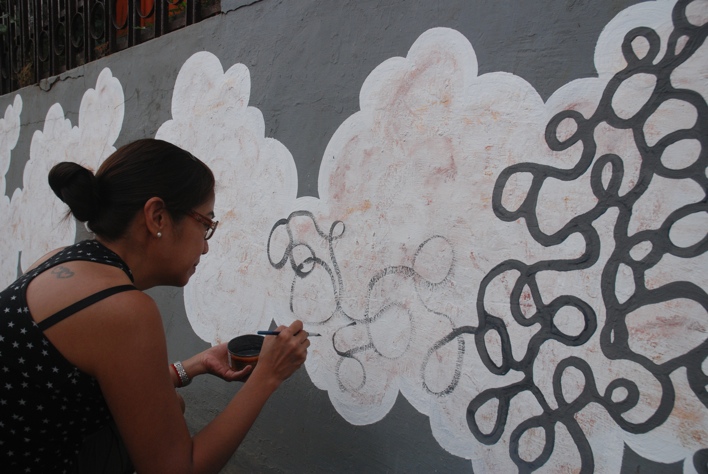
Twists and Turns – A mural by Marika Constantino


Twists and Turns
‘Balancing Paradoxes and Paradigms’ – A mural by Marika Constantino


Manila-based visual artist Marika Constantino and I first met at Arte Polis 3 (http://arte-polis.info/) in 2010, a biannual conference organized by the department of architecture at the Institute of Technology Bandung (ITB). During this conference I organized a roundtable discussion on public space and Marika was one of the discussants (subsequently, I published an essay in Tempo Magazine based on this discussion). And when she told me that she would return to Bandung to participate in Arte Polis 4, we started discussing what we could do during her stay at Roma Arts. We decided on two projects: first, a talk about 98B (http://www.98-b.org/) in collaboration with Common Room Networks Foundation (http://commonroom.info/, for more info: http://fatumbrutum.blogspot.com/2012/07/marika-constantino-gave-talk-about-98b.html); and second, a mural at Roma Arts (Jalan Cibeunying Kolot III no.41, Sadang Serang, Bandung). And she was anxious about both; both meant a stepping out of her comfort zone. And both turned out fantastic.

In three ways the mural was a first for Marika. First, she had never worked before with this medium. Second, she had never worked on such a large size (1080x120cm, the largest she ever worked on was approximately 200x100cm). And third, she had never worked outdoors with a live audience: kids who helped out, who looked over her shoulder and commented on her work; thus far, she had always separated creating from exhibiting work, solitude of and focus in the studio from the art space. Creating a mural comes closer to her curatorial practice, especially the project ‘Juan for Trees (143s)’ at the Cultural Center of the Philippines for the 2009 Green Earth Day (http://www.culturalcenter.gov.ph/).

Every day, kids play in front of my house: they play badminton, soccer and with kites on the street until dusk at around 6pm (there are no street lights). They also come to my house to see my dogs in action: Bobi – the 3-year-old, hyperactive boxer – and Ucil – the 9-year-old mellow Golden Retriever. To me it came as no surprise that they would gravitate around Marika as soon as she started her work on the mural. However, when we invited them to come into the house and help cutting and painting the figures for the mural, I wasn’t too sure if they would have the attention span to do a good job, but in fact they did. At first only the boys came in, some of whom like to tease other kids, so the girls didn’t come in at first, but when they saw the boys were taking it seriously some girls joined the fun. And after they were finished, we added their names onto the figures.

When the time came to glue the figures onto the wall, the kids came back to look for their name. And while looking for their own name, they pitched in to glue the figures onto the wall. When this was finished, Marika added a layer of emulsion and small mirrors. She added the mirrors only after the sun had set, so the kids would find a surprise the next morning. And when they returned, they interacted with the wall by making funny faces in the mirrors. But is this participatory art? Perhaps not; and for a simple reason: they don’t have a notion of (contemporary) art. They helped a new friend and had fun in the process.

Some regard public art as vandalism (especially graffiti). Some others regard public art as political. Public art isn’t always vandalism (what about all the statues in our cities celebrating ‘our’ heroes?). And public art isn’t always political (it is people who create public places for their political purposes). Marika’s mural is neither vandalism nor political (it is farfetched to judge her mural in terms of the recent Arte Polis 4 conference, i.e. as connectivity and place making).

Without a single exception, all my neighbors responded positively. They pointed at other possible walls to be turned into murals. And they called Marika’s work beautiful, attractive, pretty, great and etcetera. Even though, in contemporary art beauty has become a taboo – an artwork has to mean something discursively, as if the sensuous isn’t meaningful.

A mural sounds more permanent that it probable is. How many soccer balls will bounce of the wall in the coming months? Grass will seep through the cracks in the wall, sunshine and rain will do their work as well. All this, inevitably, will alter Marika’s work, a work with her signature repetitive pattern. And our perception of this repetitive pattern is permutated by movement – on foot, bike or by car – and changing light conditions. And how will the experience of creating a mural change Marika’s future creative process and output?

I thank Marika for our warm friendship and her spirited work on the fantastic mural. I also thank Ricky for his extensive documentation (http://www.facebook.com/media/set/?set=a.3806627759084.159909.1079114434&type=1), all the friends who stopped and pitched in (Professor Haider, Jeanne&Scott, Ami, Irfan, Rika, Siesca&Danu), my wife Mei, her three Oma Anna assistants – Anis, Pipin and Nita – and, of course, the kids who all kindly helped. For all of us, this challenging project has been a life enriching experience.

Roy Voragen
Roma Arts, Bandung, Indonesia
July 2012

Tuesday, July 10, 2012

Marika Constantino's mural at Roma Arts - artist statement


Balancing Paradoxes and Paradigms

Paradox – impossibility, enigma, puzzle, contradiction, irony
Paradigm – example, model, patter, archetype, standard

The concept of this work is based on the abovementioned definitions.  As we go through our own paths we must somehow find a sense of equilibrium in managing the supposed unattainable and the norm.  It also takes into consideration two perspectives.  From the eyes of the child, everything is play.  With imagination, things are doable, viable and fun.  As the owners of the street, I wanted them to see themselves in the mural.  Having the kids participate in the creative process will hopefully give them ownership of the final output.

On the other hand, adults tend to forget these child-like moments of exuberance and excitement.  We must not.  Let us reflect on the times when we ourselves felt much enthusiasm and looked forward to the possibilities that the next day had to offer (as the kids showed me while I was working).

The mural also intends to symbolize the many directions and options we can, should and do take.  At the end of the day, it is a matter of choice.  On the off chance that it ends up not to our liking, there are other avenues.  Like children who have resilience and adaptability… we learn, we adjust and we move on.

Marika Constantino
Roma Arts, Bandung, Indonesia
July 2012

Marika Constantino's mural at Roma Arts - day 3&4


More photos:
http://www.facebook.com/media/set/?set=a.3806627759084.159909.1079114434&type=1

Sunday, July 8, 2012

Marika Constantino gave a talk about 98B at Common Room


July 4, Manila-based visual artist Marika Constantina gave a talk at Common Room Networks Foundation (http://commonroom.info/) about 98B Art COLLABoratory (http://www.98-b.org/). We had a good discussion, we shared ideas and experiences. Firstly, on why we need places like Common Room (Bandung) and 98B (Manila). Second, on how we can sustain these place (financially, organization and concerning ideas). Thirdly, on how we can foster ties between Bandung and Manila.

Gustaff (director Common Room) tweeted live during the discussion: http://chirpstory.com/li/12514

More photos:

Marika Constantino's mural at Roma Arts - day 1